Blog
LMS Migration Project Plan: A Complete Guide with Adaptable Template
Plan your LMS migration step by step: week-by-week project plan, data mapping matrix, UAT checklist, and a multi-region rollout template. Updated 2026.

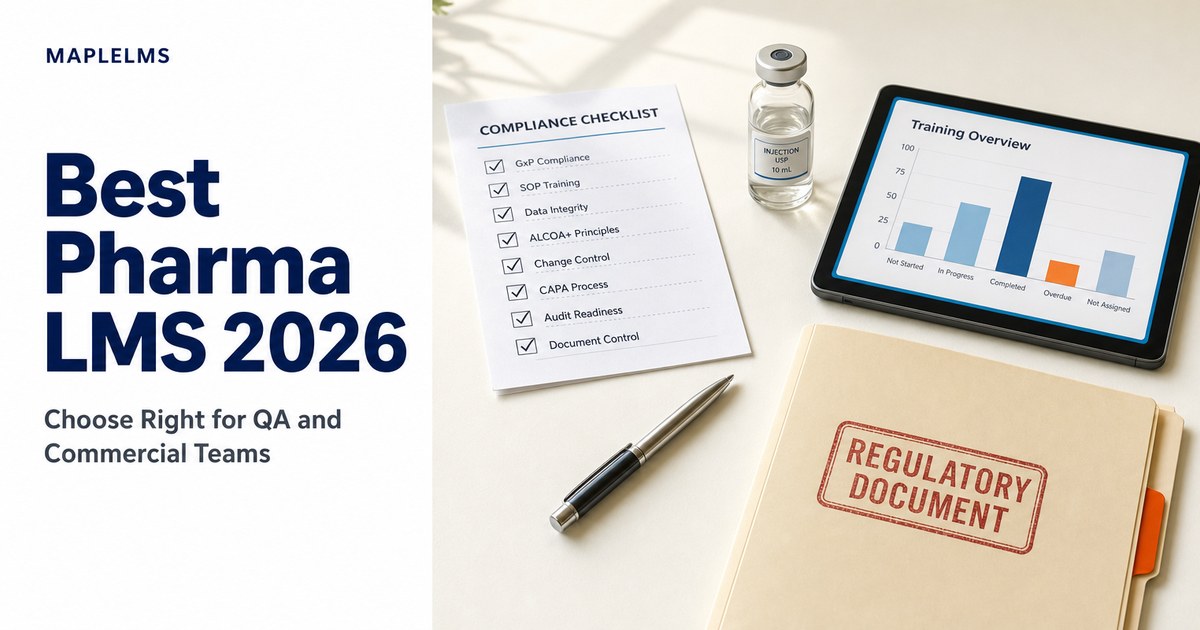
Compare pharma LMS platforms by 21 CFR Part 11 controls, Salesforce fit, GxP records, and validation support. A buying guide for commercial, QA, and R&D teams.
Plan your LMS migration step by step: week-by-week project plan, data mapping matrix, UAT checklist, and a multi-region rollout template. Updated 2026.
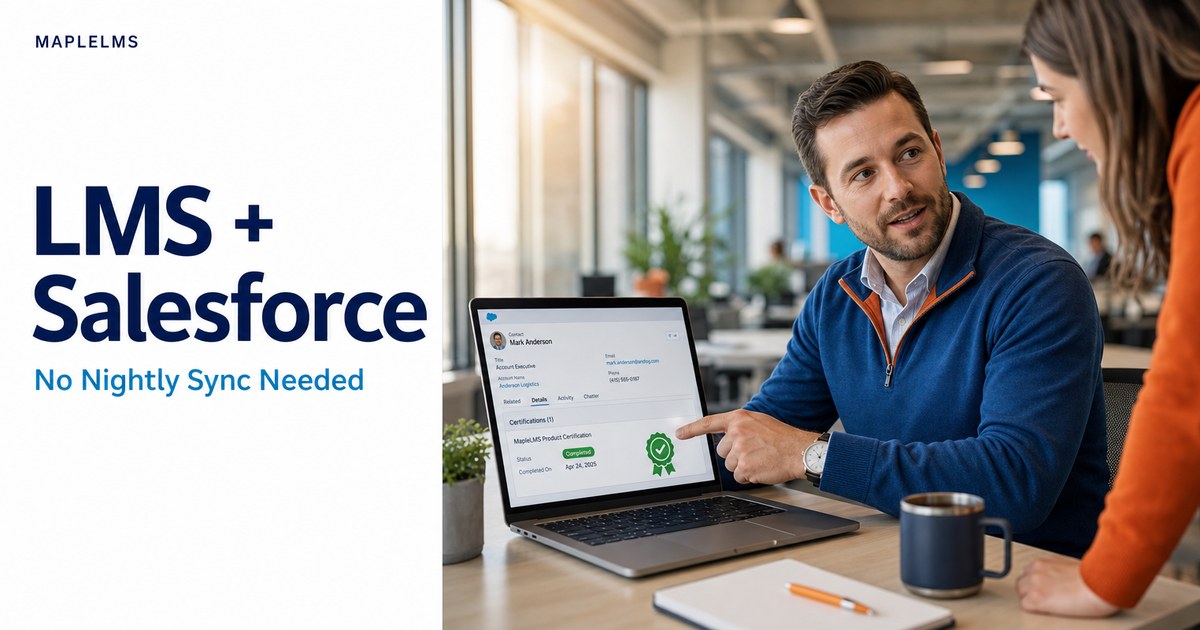
Learn how LMS integration with Salesforce works, which architecture eliminates nightly syncs, and how to evaluate AppExchange LMS apps before you commit.

Learn how retail chains use a Learning Management System to train frontline staff on new products and promotions by location, even with high turnover.
Request a quote and our experts will contact you within 24 hours with tailored solutions and pricing.
You can also send us a quick email at sales@maplelms.com.
MapleLMS
Last updated: Oct 17, 2026
By Surbhi Bhatia, Content Coordinator, MapleLMS Surbhi Bhatia has written on regulated-industry learning technology and Salesforce ecosystems for five years, covering pharma, clinical research, and enterprise compliance at MapleLMS.
A pharma Learning Management System (LMS) is a training platform built to meet the record-keeping, electronic signature, and audit-trail requirements of regulated life sciences environments - and choosing the wrong category costs far more than a failed demo.
Commercial teams find reps in front of Healthcare Professionals (HCPs) before certification is complete. QA teams spend five days pulling records before an inspection. IT teams inherit a sync connector that breaks with every Salesforce release. Each failure traces back to a procurement decision made before anyone asked the right questions.
This guide gives commercial, medical, and quality teams a structured way to evaluate pharma LMS options. It covers what separates field-training platforms from Quality Management System (QMS)-embedded modules, which compliance controls actually matter, how to stress-test an AI claim, and where a Salesforce-native approach changes the comparison entirely.
Key Takeaways
- A pharma LMS and a QMS-embedded training module serve different jobs. Match the platform to your buying centre - Commercial Excellence or Quality Assurance - and most candidates disappear quickly.
- 21 CFR Part 11 controls (unique user IDs, electronic signatures, and immutable audit trails) are the compliance floor. Ask vendors to demonstrate them live. Your organisation's own quality and validation processes govern what you must validate yourself.
- In MapleLMS's 2024 anonymised Life Sciences migration, compliance tracking fell from 5 days to under 1 day and training completion rose from 68% to 91% across 150,000+ learners (MapleLMS Cornerstone migration case study, 2024).
- A 100% Salesforce-native LMS eliminates the sync connector your IT team would otherwise maintain.
- AI features in a regulated-industry LMS require a written commitment that your clinical content never reaches a public model.
Note: Independent market data for pharma LMS adoption was not available within the source policy window. All figures cited below are from MapleLMS's own case studies and evidence pack, attributed accordingly.
A pharma Learning Management System (LMS) is a training platform built to meet the specific record-keeping, electronic signature, and audit-trail requirements of regulated life sciences environments. Unlike a general corporate LMS, it must support 21 CFR Part 11 controls, Good Practice (GxP) training traceability, and IQ/OQ/PQ validation - features that determine whether training records will withstand an FDA inspection. In MapleLMS's 2024 anonymised Life Sciences migration (Cornerstone OnDemand, 150,000+ learners), compliance tracking fell from 5 days to under 1 day once the platform matched those regulated-environment requirements (MapleLMS Cornerstone migration case study, 2024).

21 CFR Part 11 is the US FDA regulation (eCFR Title 21, Part 11, 2024) requiring that electronic records and electronic signatures be as trustworthy and legally binding as paper records. For an LMS, that means three things a general corporate platform almost certainly cannot prove:
Good Practice (GxP) is a collective term for quality guidelines covering pharmaceutical manufacturing (Good Manufacturing Practice, or GMP), clinical trials (Good Clinical Practice, or GCP), and laboratory operations. GCP guidelines are maintained by the International Council for Harmonisation (ICH GCP, 2024). A pharma LMS must produce training records that satisfy GxP traceability requirements across all three settings.
IQ/OQ/PQ stands for Installation Qualification, Operational Qualification, and Performance Qualification. It is the three-phase process proving a regulated system behaves as specified in your operating environment. A general LMS vendor cannot supply this. A pharma-ready one provides supporting documentation. Your QA team executes the process and owns the outcome.
The practical difference is straightforward: a general LMS may claim "compliance-ready." A pharma LMS can produce a Part 11-compliant audit trail on demand and supply validation documentation to support it. Compliance is supported, never guaranteed - your team's validation work is always required.
A field-training LMS and a Quality Management System (QMS)-embedded training module are built for different jobs. A field-training LMS connects to your Customer Relationship Management (CRM) system, assigns certification by territory and role, and surfaces readiness data where commercial leaders work. A QMS-embedded module triggers retraining when a document changes inside the same quality system. Knowing which job is your primary need is the fastest way to eliminate candidates from your shortlist.

The table below maps the two approaches across the dimensions that matter most at shortlist stage:
| Evaluation dimension | Field-training LMS | QMS-embedded training module |
|---|---|---|
| Primary buying centre | Commercial Excellence, Sales Enablement, L&D | Quality Assurance, Regulatory Affairs |
| Training trigger | Role change, product launch, certification expiry | SOP or document revision inside the QMS |
| CRM integration | Native or deep integration | Typically limited or absent |
| Audit trail | Standalone, exportable compliance record | Tied to document revision history in the QMS |
| Validation ownership | Vendor provides IQ/OQ/PQ support; customer validates | Shared with QMS vendor; broader validation scope |
| Extended enterprise | Partners, distributors, HCPs, external learners | Primarily internal employees |
| Offline mobile | Often yes, via native app | Rarely; usually browser-based |
| Salesforce fit | Built-in for native platforms | Requires custom integration |
Choose a dedicated field-training LMS when your primary pain is launch readiness. If reps need to be certified on a new product, for a specific territory, before a launch date - and commercial leaders need to see that status in Salesforce - a QMS-embedded module cannot serve that job. It was not designed to.
If a Standard Operating Procedure (SOP) change inside document control must automatically trigger retraining in the same system, without a separate integration, then an Electronic Quality Management System (eQMS) training module is the right tool. An eQMS is a digital system managing document control, Corrective and Preventive Action (CAPA), and training workflows inside one quality suite. Platforms built natively inside quality suites handle that closed loop better than any external LMS.
Many mid-size and large pharma companies run both: an eQMS training module for manufacturing and lab SOPs, and a Salesforce-native LMS for commercial, field force, and extended enterprise training. The two systems connect via API. QMS-triggered retraining writes completion records back to the LMS audit trail. Neither tool replaces the other.
Leading Learning Management System (LMS) providers for pharma divide into two lanes: commercial-team platforms designed for field force certification and Salesforce integration, and Electronic Quality Management System (eQMS)-embedded platforms for SOP-triggered retraining inside a single quality system. Commercial platforms put training data next to CRM pipeline data. eQMS platforms keep training inside document control workflows. The right choice depends on whether your buying centre is Commercial Excellence or Quality Assurance - not on which vendor has the most impressive demo.

The table below positions the main platform categories by use case, Salesforce fit, and Part 11 controls:
| Platform category | Built for | Salesforce-native | Part 11 controls | QMS integration | Best fit |
|---|---|---|---|---|---|
| Salesforce-native commercial LMS | Field force, commercial teams, extended enterprise | Yes | Yes, standalone | Via API | Commercial Excellence, Sales Enablement |
| eQMS-embedded training module | Quality and manufacturing teams | No | Yes, tied to document control | Native within QMS | Quality Assurance, Regulatory Affairs |
| Validated GxP content library | Regulated course delivery | No | Varies | Limited | Buyers needing pre-built GMP/GCP courses |
| General enterprise LMS | Broad corporate L&D | Connector required | Partial; needs configuration | Via connector | Non-regulated training at scale |
| Frontline microlearning platform | Retail, CPG, frontline workers | Varies | Usually absent | Limited | Mobile-first, low-regulation environments |
MapleLMS sits in the Salesforce-native commercial LMS lane. The 2025 CMAX case study shows what that means at a regulated site: approximately 500 internal and external learners at an Australian early-phase clinical research organisation, covering FDA, GxP, and Health Insurance Portability and Accountability Act (HIPAA) training, with competency-linked assignments tied to each role. The result was 86% user adoption (MapleLMS CMAX case study, 2025).
At a compounding pharmacy, Casa Pharma Rx achieved 96% user adoption for product training across sales and customer-service teams (MapleLMS Casa Pharma Rx case study, 2025).
Our data: In MapleLMS's 2024 anonymised Life Sciences migration from Cornerstone OnDemand - covering 150,000+ learners across North America, Europe, and APAC - learner engagement increased by 42%, training completion rose from 68% to 91% (MapleLMS Cornerstone migration case study, 2024), and reporting turnaround moved from 2-3 days to real time. LMS administration effort fell by 35%.
MapleLMS holds a 4.8-out-of-5 rating on G2 across 17 reviews, with 85.7% of reviewers in the mid-market segment (G2, 2025). On the Salesforce AgentExchange legacy listing, the rating is 4.96 from 92 reviews (AgentExchange, 2025).
Book a Demo with MapleLMS
For a mid-size pharma company running on Salesforce, MapleLMS is a direct fit as a 100% Salesforce-native Learning Management System: it runs inside Salesforce infrastructure on standard objects, with no external database, no sync connector, and no second login. A new user provisioned in Salesforce auto-triggers role-specific onboarding. In MapleLMS's 2024 anonymised Life Sciences migration (Cornerstone OnDemand, 150,000+ learners), compliance tracking fell from 5 days to under 1 day, and administration effort dropped by 35% (MapleLMS Cornerstone migration case study, 2024).

Salesforce-native means the LMS runs entirely within Salesforce infrastructure using standard Salesforce objects and permissions. There is no external database. Your IT security team reviews it like any other managed package. Reps use Salesforce Single Sign-On (SSO) - a method letting users access multiple applications with one set of credentials - with no second password to manage.
Salesforce-integrated means the LMS lives outside Salesforce and pushes or pulls data via a connector or API. That connector needs maintenance, monitoring, and re-testing after every Salesforce release. Data can go out of sync. Dashboards disagree with the CRM. Your IT team owns a second system.
At shortlist stage, ask each vendor one question: "Where does our learner data physically live?" If the answer includes any server or database outside Salesforce, the platform is integrated, not native.
Even with a Salesforce-native pharma LMS, your QA team must execute and document IQ/OQ/PQ validation in your own Salesforce org. MapleLMS provides supporting IQ/OQ/PQ documentation. Your team applies those documents to your specific user roles and training workflows. The platform supports the process - your organisation owns the outcome.
Compare pharma Learning Management Systems across four criteria in this order: (1) 21 CFR Part 11 and GxP controls as the non-negotiable compliance floor; (2) validation support - whether the vendor provides IQ/OQ/PQ documentation or leaves it entirely to you; (3) CRM and QMS fit, covering how training data connects to your systems of record; (4) content library, relevant only if your primary need is pre-built GxP courseware. For L&D administrators, MapleLMS's 2024 Cornerstone migration cut LMS administration effort by 35% across 150,000+ learners - a practical proxy for platform fit (MapleLMS Cornerstone migration case study, 2024).
The table below turns that framework into a practical scoring tool:
| Criterion | What to ask the vendor | What a strong answer looks like |
|---|---|---|
| 21 CFR Part 11 controls | "Show me a live audit trail export for a completed course." | Time-stamped, user-attributed, immutable record exported in seconds |
| Electronic signatures | "Walk me through the signature workflow for a completion." | Unique credential prompt, not a click-through |
| IQ/OQ/PQ support | "What validation docs do you provide, and who executes them?" | Vendor supplies documents; your QA team executes and owns validation |
| SOC 2 Type II | "Can we see the report, not just the badge?" | Full report under NDA; MapleLMS is SOC 2 Type II certified (2025) |
| ISO 27001 | "Is the certification displayed on your site?" | Badge live, issuer verifiable |
| CRM fit | "Where does learner data live relative to our Salesforce org?" | Native: same org, no external DB. Integrated: separate server, sync required |
| QMS integration | "How does an SOP revision in our QMS trigger retraining?" | Documented API, tested trigger, completion record written back |
| AI data handling | "Provide a written commitment that our content never reaches a public model." | Written data processing agreement; AI operates inside SOC 2 boundary |
| Validation timeline | "How long does IQ/OQ/PQ typically take for a customer like us?" |
Different stakeholders weight these criteria differently. Structure your demos accordingly:
MapleLMS is a Salesforce-native commercial LMS and is not designed for organisations whose primary training trigger is an SOP revision inside a document control system. An Electronic Quality Management System (eQMS) is a digital platform managing document control, Corrective and Preventive Action (CAPA), and training inside one quality workflow - MapleLMS integrates with eQMS tools via API but does not replace them. It also does not offer a pre-built validated GxP content library or on-premise deployment.
Two buyer categories are better served elsewhere:
The differences that matter are rarely shown in demos. Ask vendors to prove data flow: where do learner records physically live, and how does a Salesforce role change trigger a new assignment? Test audit trail export speed and format. Confirm whether the AI layer sends your content to a public model. Ask for IQ/OQ/PQ documentation - that separates purpose-built pharma platforms from generic tools with compliance marketing.
For teams with an existing Quality Management System (QMS), the right Learning Management System (LMS) integrates with it rather than replacing it. Look for a platform that receives a trigger when a Standard Operating Procedure (SOP) changes, assigns updated training automatically, and writes completions back in a format your QMS can read. The LMS handles training delivery; the QMS handles document control and Corrective and Preventive Action (CAPA). They connect via API.
Ask for a SOC 2 Type II report - not just a badge. Request a sample audit trail export showing time-stamped, immutable entries for a completed course. Confirm whether the vendor supplies IQ/OQ/PQ validation documentation and who executes it. Ask for reference customers in a comparable regulatory environment. Many pharma case studies are anonymised by contract - that is normal, not a red flag. MapleLMS is SOC 2 Type II and ISO 27001 certified (compliance page, 2025).
Request a written data processing agreement stating your content is never used to train external models and never transmitted to a public large language model (LLM). Ask which AI infrastructure the vendor uses, who hosts the inference layer, and whether it operates inside your existing security boundary. A SOC 2 Type II report covering AI features is strong supporting evidence. If a vendor cannot produce a written commitment, treat AI features as disqualifying for clinical content.
21 CFR Part 11 (eCFR, 2024) is the US FDA regulation requiring electronic records and signatures to be as trustworthy as paper. Proof requires unique user identification, electronic signature controls at completion, and immutable audit trails - ask vendors to demonstrate each live. Even with a compliant platform, your organisation must execute and document its own IQ/OQ/PQ validation. The platform supports your compliance process; it does not perform it for you.
Choosing the right pharma Learning Management System starts with one question asked before any demo: is your primary buying centre Commercial Excellence or Quality Assurance? That answer points you to a different platform category, a different set of vendor questions, and a different definition of success.
For commercial and field-force training in a Salesforce environment, native data architecture, real-time certification visibility, and offline mobile capability matter most. For QA-driven training inside a quality system, the criteria shift to document-triggered retraining and eQMS integration. MapleLMS's 2024 anonymised Life Sciences migration (Cornerstone OnDemand, 150,000+ learners) cut compliance tracking from 5 days to under 1 day and raised training completion from 68% to 91% - when the right platform fits the right job (MapleLMS Cornerstone migration case study, 2024).
Five decisions to carry into your next vendor conversation:
For a closer look at the Salesforce-native architecture, certification dashboards, and audit trail in your own environment:
Book a Demo with MapleLMS

© 2026 MapleLMS All rights reserved.


| Specific weeks, not "it depends" |
| Content library | "Do you offer pre-built, validated GxP courses?" | Honest answer: general LMS platforms typically do not; specialist vendors do |